
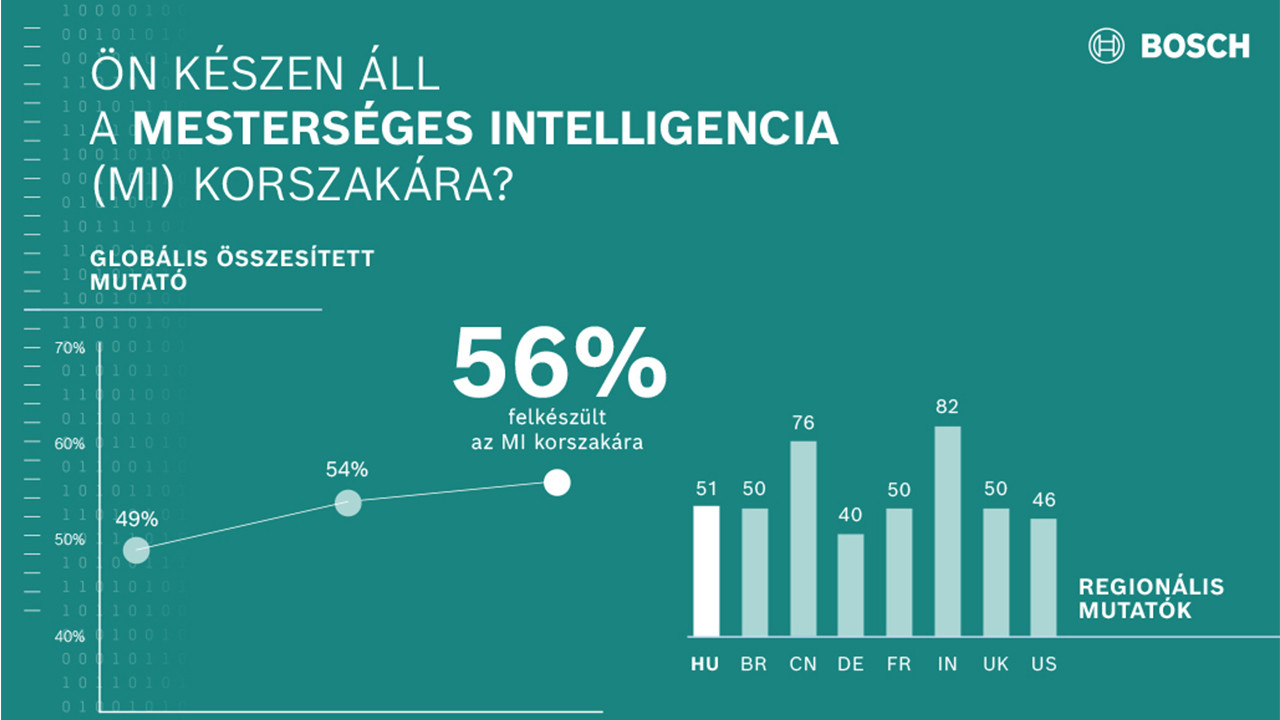
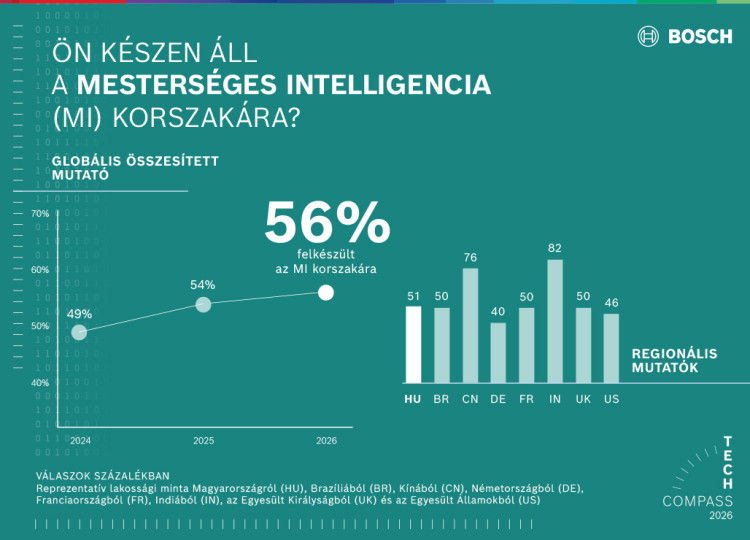
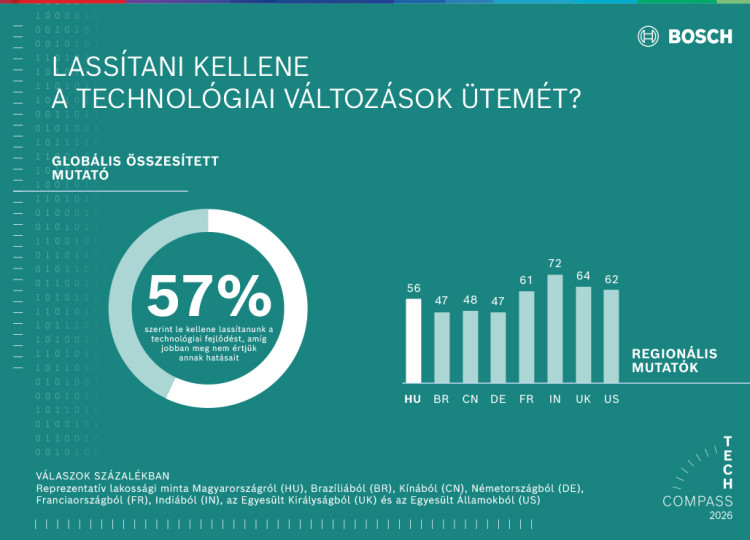
The world is ready for the era of artificial intelligence (AI). This broad consensus emerged among the more than 12,000 people surveyed worldwide and in Hungary for this year's Bosch Tech Compass survey. Respondents have never viewed artificial intelligence as positively as they did in this latest survey. Similar to the previous survey, the majority continue to believe that AI will be the most influential technology in the next decade and that, of all technologies, it will have the most positive impact on society. More than half of those surveyed (56 percent worldwide, 51 percent in Hungary) feel that they are ready for the era of artificial intelligence. At the same time however, there are signs of exhaustion due to the continuous and rapid development of technology. 57 percent of respondents worldwide indicated that they would like a momentary pause and would be happy to slow down technological change until we better understand its effects. The results were similar in Hungary: 56 percent of survey participants agreed with this statement.



Hungarians are becoming increasingly optimistic
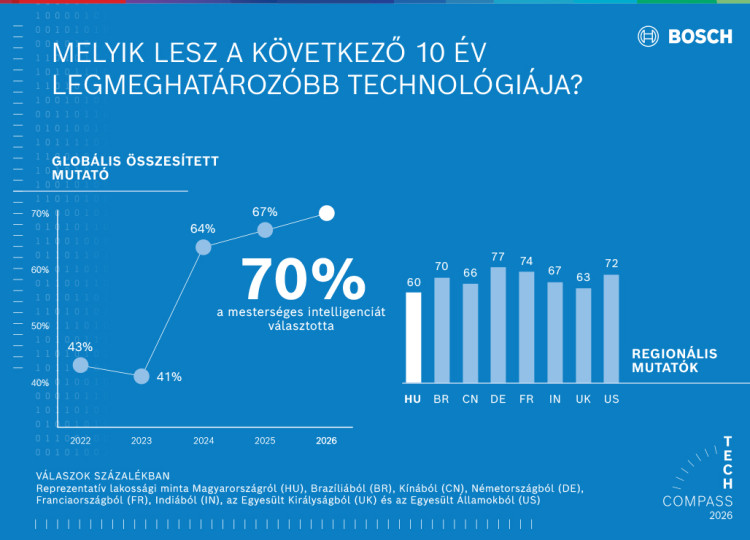
Compared to last year, scepticism about development has decreased among Hungarian respondents. Following last year’s 53 percent, this year 60 percent of users consider AI to be the most influential technology of the next decade. In 2025, 56 percent believed that technological development will make the world a better place, while in 2026, 62 percent hold this view. Interestingly, German (59 percent) and French (53 percent) respondents are more sceptical about this issue.
“The results of the Bosch Tech Compass survey in Hungary this year have once again highlighted that, as a leading responsible innovation company and one of the largest employers in the country, we have a big role in promoting social openness and acceptance of technologies, including artificial intelligence. With the number of innovative AI solutions increasing rapidly worldwide and becoming part of everyday life, our goal is to support people in learning about the technology, mastering it, and preparing for its safe use,” said Teodóra Bodó, director of communication and governmental affairs of the Bosch Group in Hungary and the Adriatic region.
Artificial intelligence has the biggest positive and negative impact
AI will not only be the most influential technology of the next decade, but it will also have the biggest positive impact on society – according to 43 percent of respondents worldwide, including 47 percent of Hungarians who took part in the survey. In the ranking, artificial intelligence is followed by biotechnology and industrial robots: in the case of both technologies, 35-35 percent of Hungarian respondents expect positive impact in the future. However, users also see negative aspects: when it comes to negative impacts on society, 27 percent of Hungarian respondents rank AI above any other technology. In second place, with 23 percent, are humanoid robots, which is in line with the global figure. “It is not surprising that this year's international survey once again produced ambivalent results regarding artificial intelligence, with the majority of people attributing both the biggest positive and negative effects to this technology. That is why we at Bosch have a clear mission: innovation and responsibility must go hand in hand. We consider education and regulation to be of paramount importance in ensuring that artificial intelligence is reliable in all areas of life,” emphasized Teodóra Bodó.
53 percent of respondents would support their child in launching a startup
A positive attitude towards innovation and risk-taking is also a cultural issue: on a global level, 59 percent of respondents would support their child in launching a startup instead of pursuing university studies if they had a groundbreaking idea. Among Hungarian respondents, 53 percent would be this brave in taking risks. However, it’s only through this courage that the solutions of tomorrow are created. When people were asked what areas technological innovation should focus on, climate change (global and Hungarian data: 37-37 percent), access to healthcare (global data: 31 percent, Hungarian data: 33 percent), and cybersecurity (global data: 28 percent, Hungarian data: 18 percent) were the most common responses.
“In order for society to use artificial intelligence reliably and responsibly, it is necessary to acquire important skills such as critical thinking and cybersecurity awareness. In 2020, Bosch has already formulated its own AI code of ethics, which provides clear guidelines for our employees in the development and use of intelligent products. On the Bosch Hungary IoT blog and podcast channel, we share content that calls attention to the safe and responsible use of the latest innovations, including artificial intelligence,” highlighted Teodóra Bodó.
About the study
For the Bosch Tech Compass survey, the Gesellschaft für Innovative Marktforschung mbH (GIM) surveyed more than 12,000 people over the age of 18 in seven countries in the fall of 2025. The number of respondents was 1,000 in the United Kingdom, France, Hungary, and Germany each, while in the United States, Brazil, India, and China it was 2,000 each. Commissioned by the Bosch Group in Hungary, the representative survey was conducted for the second time in Hungary. Bosch was not named as a client at any point during the survey.
Mónika Hack
+36 70 510 5516
Bosch has been present in Hungary since 1898 with its products. After its re-establishment as a regional trading company in 1991, Bosch has grown into one of Hungary’s largest foreign industrial employers with currently nine subsidiaries. In fiscal 2024 it had total net sales of 2058 billion forints and consolidated sales to third parties on the Hungarian market of 313 billion forints. The Bosch Group in Hungary employs more than 17,400 associates (as of December 31, 2024). In addition to its manufacturing, commercial and development business, Bosch has a network of sales and service operations that covers the entire country.
The Bosch Group is a leading global supplier of technology and services. It employs roughly 418,000 associates worldwide (as of December 31, 2024). The company generated sales of 90.3 billion euros in 2024. Its operations are divided into four business sectors: Mobility, Industrial Technology, Consumer Goods, and Energy and Building Technology. With its business activities, the company aims to use technology to help shape universal trends such as automation, electrification, digitalization, connectivity, and an orientation to sustainability. In this context, Bosch’s broad diversification across regions and industries strengthens its innovativeness and robustness. Bosch uses its proven expertise in sensor technology, software, and services to offer customers cross-domain solutions from a single source. It also applies its expertise in connectivity and artificial intelligence in order to develop and manufacture user-friendly, sustainable products. With technology that is “Invented for life,” Bosch wants to help improve quality of life and conserve natural resources. The Bosch Group comprises Robert Bosch GmbH and its roughly 490 subsidiary and regional companies in over 60 countries. Including sales and service partners, Bosch’s global manufacturing, engineering, and sales network covers nearly every country in the world. Bosch’s innovative strength is key to the company’s further development. At 136 locations across the globe, Bosch employs some 87,000 associates in research and development
Additional information is available online at www.bosch.hu, iot.boschblog.hu, www.bosch.com, www.iot.bosch.com, www.bosch-press.com, www.twitter.com/BoschPresse