
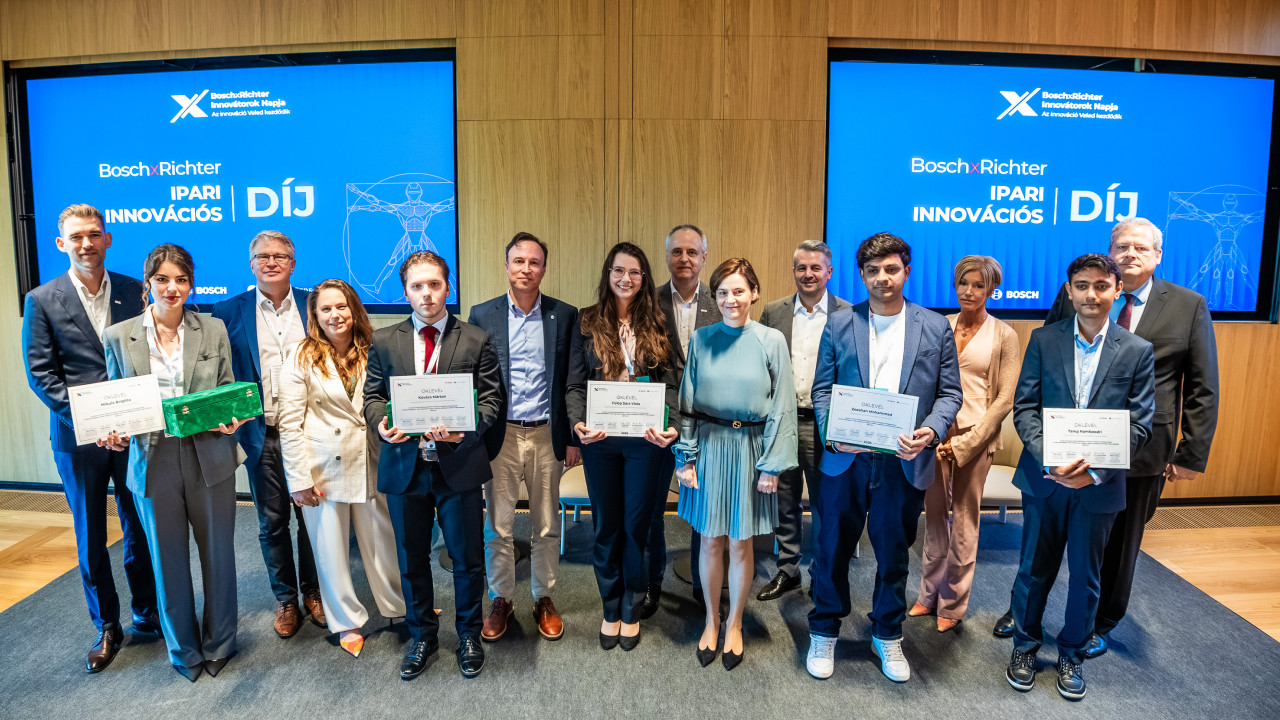
Budapest – How can the latest technologies contribute to our health or to safe and sustainable transportation? Can the mobility of the future be both efficient and environmentally friendly? What solutions can help the visually impaired move more safely on the streets? Can the behavior of children with attention deficit disorder be studied in more depth, even while playing? These are just some of the complex challenges for which the promising young talents who won a 2026 BoschxRichter Industrial Innovation Award sought forward-looking solutions.


The Bosch Group in Hungary and Richter Gedeon Plc. announced their third annual “See into the Future!” competition this year for university and college students. Students could submit their entries in the areas of healthcare and mobility, in individual or team categories.
With the joint award, the two companies aim to encourage the talents of Generation Z in the fields of transportation and medicine to think innovatively, solve today’s most pressing problems, and develop fresh ideas. The competition, which carries on the innovation legacy of the founders, Robert Bosch and Gedeon Richter, successfully attracts more and more young people every year.
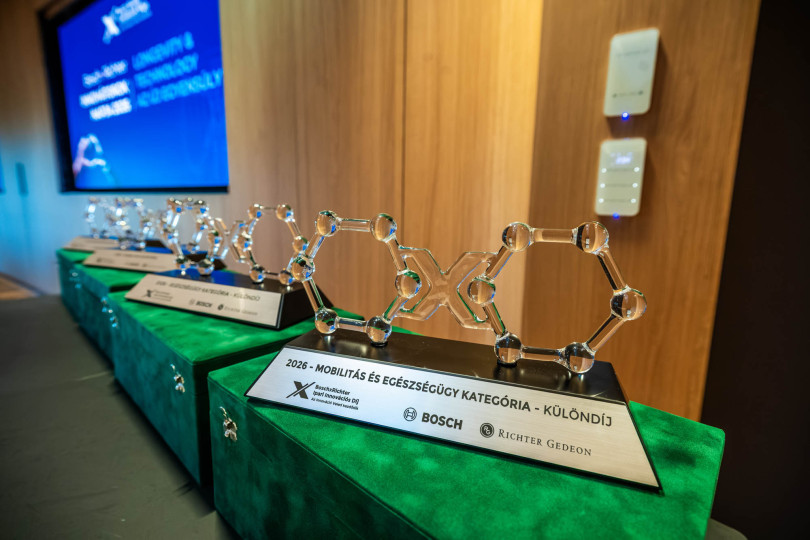
The BoschxRichter Industrial Innovation Award 2026 was won by two individual applicants and one team, and the jury also recognized the work of two other candidates with a special award. The awards, which include cash prizes, were presented at the BoschxRichter Innovators Day at the Richter Centre in Budapest on September 23, 2026.
Critical raw materials could run out: rare-earth-free propulsion may become a key issue
The number of electric cars, eBikes, e-scooters and robots will continue to grow in the next decade, so the demand is increasing for reliable, quiet and maintenance-free drives. “It is not enough to make the drive system of the future stronger or more efficient – sustainability is just as critical,” emphasized Brigitta Mikula, a student at the Budapest University of Technology and Economics. In her award-winning application, she presented a drive that transmits torque using magnetic force instead of traditional gears. This future-proof solution not only results in lower wear, less noise and less maintenance, but since it is made using iron–nickel, it does not require rare earth metals for its production. Brigitta Mikula’s novel approach not only represents a technological advance but can also contribute to a more sustainable future – making her the individual winner in the mobility category of the BoschxRichter Industrial Innovation Award.
Virtual zoo on a tablet: behavioral analysis game could help to map attention deficit disorders
The number of children with attention disorders has increased significantly in Hungary in recent years. Yet there are few tools available that can collect measurable data on their behavior quickly, objectively and in a child-friendly manner. Áron Paskuj, a sixth-year medical student at the University of Szeged, sought a solution to this very problem in his application. Cogniroots is a digital behavioral analysis platform that can observe children’s behavior during gameplay. While they build a virtual zoo on their tablet, the tool continuously records their decisions, reaction times, changes in their attention and more in the background. “The most important thing is to gain a more nuanced and insightful understanding of the children, while still ensuring that it remains a fun experience for them,” emphasized Áron Paskuj. The individual winner in the healthcare category of the BoschxRichter Industrial Innovation Award developed a unique solution that can help professionals in their work, from child psychiatric screening to diagnostic decisions and follow-up care.
AI behind the wheel: the car of the future also pays attention to diversity
Smart cars are the main characters in the future of transportation, with an increasing number of their functions based on artificial intelligence. One such feature is the driver monitoring system that detects driver fatigue and lapses in attention, which all new cars in the EU are required to have since the summer of 2026. High-quality data is needed for these systems to work reliably, but there is a major challenge. AI may be less accurate when applied to certain groups, such as women, the elderly, people with darker skin tones, or those who wear glasses. Mohammad Zeeshan and Tanuj Namboodri, students at Eötvös Loránd University and the University of Miskolc, sought a solution to this problem in their project. Their concept, the award-winning TrueGaze, uses synthetic data to support the development of driver monitoring systems based on artificial intelligence and image processing. The special value of the model is that it also seeks solutions for the responsible, ethical and legally compliant use of artificial intelligence. “TrueGaze makes driver monitoring safer, fairer, and more reliable for everyone who gets behind the wheel,” summarized Mohammad Zeeshan and Tanuj Namboodri, the winning team in the mobility category of the BoschxRichter Industrial Innovation Award.
A much-needed digital ecosystem for safer pregnancy
Pregnancy is one of the most special, and at the same time, most sensitive periods in a woman’s life. In this unique life situation, expectant mothers have to navigate a sea of test results and information while being the sole link between their doctor, their health visitor, and the vast amount of health data. Sára Viola Fülöp, a student at Semmelweis University, applied a proposal for a digital healthcare platform that fills the gap by connecting the expectant mother, the public health nurse, and the attending physician within a unified system. In the system, codenamed EESZTer, the information generated during care is managed by a common data center, enabling real-time information sharing and collaboration among the participants of the process. In addition, expectant mothers receive continuous, clear education, allowing them to feel safe and supported within a transparent system. “The vision of EESZTer is simple: a perinatal care system where the system helps connect the various participants to the mother, so she is not left alone to handle this task,” added Sára Viola Fülöp. Her concept, which won the special award in the healthcare category of the BoschxRichter Industrial Innovation Award, helps with the early detection of risks and supports faster medical decision-making.
Smart white cane for the independence and safety of the visually impaired
With a traditional white cane, visually impaired people can mainly perceive obstacles only at ground level: an overhanging tree branch, a traffic light without an audible signal or a large open space can all pose a challenge for them. Márton Kovács, a student at the Budapest University of Technology and Economics, is making the traditional white cane smarter with the latest technologies. The device, called Walkira, uses sensors, GPS, a camera and intelligent navigation solutions to sense its surroundings, detect obstacles, and assist the user in orientation with voice-based feedback. “My goal is to restore security and independence to people with visual impairments,” said Márton Kovács, winner of the special award in the mobility and healthcare category at the BoschxRichter Industrial Innovation Award. According to the jury’s evaluation, his work could contribute to improving the quality of life for those affected.
Renowned experts evaluated the young people’s submissions
The winning entries were selected by a jury of renowned experts, including Judit Polgár, Olympic champion and international chess grandmaster; Zsuzsa Beke, head of global communication, CSR and public affairs at Gedeon Richter Plc.; Dr. Balázs Lendvai, head of Discovery and Preclinical Development at Richter Gedeon Rlc., head of the Richter Department at Semmelweis University; Teodóra Bodó, director of communication and governmental affairs of the Bosch Group in Hungary and the Adriatic region; and Mátyás Pótsa, director of Innovation Ecosystem at Bosch Hungary .
Short videos with the winners can be watched here.
Zita Hella Varga
Phone: +36 70 667-6374
Bosch has been present in Hungary since 1898 with its products. After its re-establishment as a regional trading company in 1991, Bosch has grown into one of Hungary’s largest foreign industrial employers with currently ten subsidiaries. In fiscal 2025 it had total net sales of 1.926 billion forints and consolidated sales to third parties on the Hungarian market of 303 billion forints. The Bosch Group in Hungary employs around 16,800 associates (as of December 31, 2025). In addition to its manufacturing, commercial and development business, Bosch has a network of sales and service operations that covers the entire country.
The Bosch Group is a leading global supplier of technology and services. It employs roughly 413,000 associates worldwide (as of December 31, 2025). The company generated
sales of 91 billion euros in 2025. Its operations are divided into four business sectors: Mobility, Industrial Technology, Consumer Goods, and Energy and Building Technology. With its business activities, the company aims to use technology to help shape universal trends such as automation, digitalization, electrification, and artificial intelligence. In this context, Bosch’s broad diversification across regions and industries strengthens its innovativeness and robustness. Bosch uses its proven expertise in hardware, software, and services to offer customers cross-domain solutions from a single source. It also applies its expertise in connectivity and artificial intelligence in order to develop and manufacture intelligent, user-friendly, and sustainable products. With technology that is “Invented for life,” Bosch wants to help improve quality of life and conserve natural resources. The Bosch Group comprises Robert Bosch GmbH and its roughly 500 subsidiary and regional companies in over 60 countries. Including sales and service partners, Bosch’s global manufacturing, engineering, and sales network covers nearly every country in the world. Bosch’s innovative strength is key to the company’s further development. Bosch employs some 82,000 associates in research and development.
The company was set up in Stuttgart in 1886 by Robert Bosch (1861-1942) as “Workshop for Precision Mechanics and Electrical Engineering.” The special ownership structure of Robert Bosch GmbH guarantees the entrepreneurial freedom of the Bosch Group, making it possible for the company to plan over the long term and to undertake significant upfront investments in the safeguarding of its future. Ninety-four percent of the share capital of Robert Bosch GmbH is held by Robert Bosch Stiftung GmbH, a limited liability company with a charitable purpose. The remaining shares are held by Robert Bosch GmbH and by a company owned by the Bosch family. The majority of voting rights are held by Robert Bosch Industrietreuhand KG. It is entrusted with the task of safeguarding the company’s long-term existence and in particular its financial independence – in line with the mission handed down in the will of the company’s founder, Robert Bosch.
Additional information is available online at www.bosch.hu, iot.boschblog.hu, www.bosch.com, www.iot.bosch.com, www.bosch-press.com.