
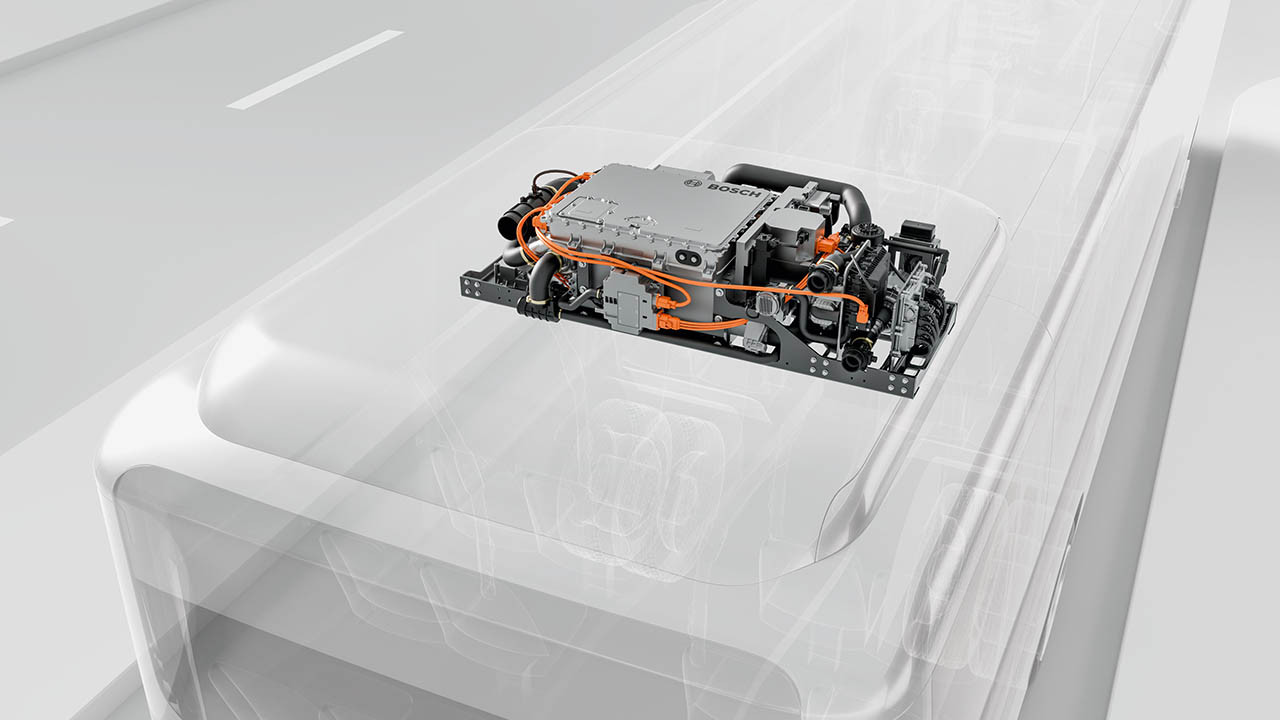
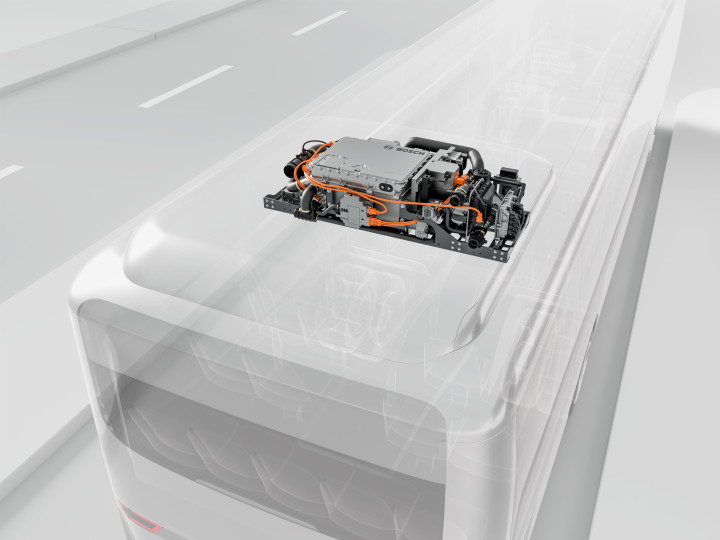
Stuttgart and Berlin, Germany – Climate-friendly solutions are becoming increasingly important in public transportation across European cities. Bosch recently unveiled the latest version of its fuel cell power module (FCPM), which offers opportunities for sustainable urban bus transportation. With this climate-neutral solution, the vehicles can be powered electrically and – when using renewable hydrogen – completely CO₂-free. . The FCPM C100 compact unit is a new addition to Bosch’s fuel-cell power module portfolio, covering a power range between 100 and 300 kilowatts. The flat module, only 40 centimeters high, was specifically designed for mounting on the roof of the vehicle—a common solution for European city buses. The easily integrable system was developed for city buses between 12 and 18 meters in length.


Climate protection is the goal
“In addition to battery-electric buses, fuel-cell electric vehicles can also be used to combat climate change” said Jan-Oliver Röhrl, executive vice president of the Bosch Power Solutions division and chairman of Bosch’s global commercial vehicle activities. “The fuel cell is especially well-suited for buses that travel longer distances every day and rarely have the opportunity to charge en route” he added. According to an EU regulation, by 2030, carbon emissions from newly registered city buses must be reduced by 90 percent compared to 2019 levels, and starting in 2040, this rule will apply to all other new bus types as well.
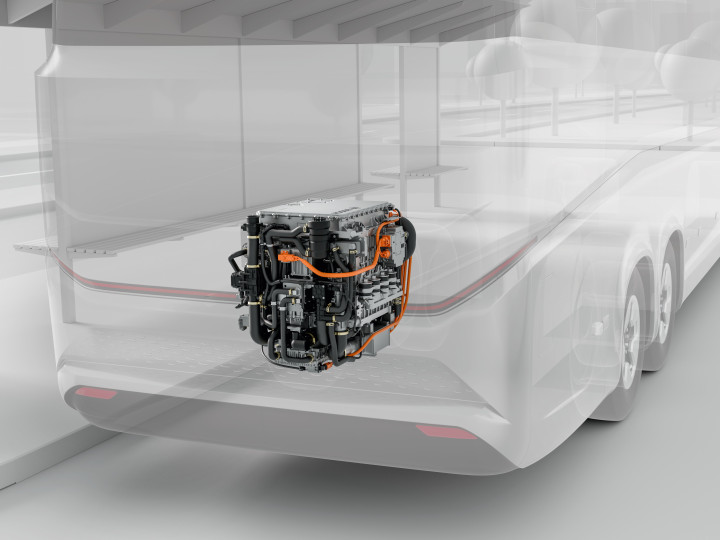
Vehicles with fuel-cell power modules, which the EU recognizes as zero-emission vehicles, can make an important contribution here. The recently introduced FCPM 100, 190, and 300 fuel cell power modules are an ideal power source for both heavy-duty trucks and intercity buses.
Bosch offers cutting-edge technology across the entire hydrogen value chain
Bosch has been committed to sustainable solutions for years. It develops a wide range of technical solutions for hydrogen production, infrastructure, and utilization. The company entered the market in 2025 with the Hybrion PEM stack for hydrogen production and is also working on hydrogen engine technology, offering components for both intake manifold and direct injection systems.
Contact person for press inquiries:
Mónika Hack
+36 70 510-5516
Anna Schmatz
+49 711 811 12715
Mónika Hack
+36 70 510 5516
Mobility is the largest Bosch Group business sector. According to preliminary figures, it generated sales of 56 billion euros in 2025, and thus contributed around 62 percent of total sales. This makes the Bosch Group one of the leading mobility suppliers. Bosch Mobility pursues a vision of mobility that is safe, sustainable, and exciting. For its customers, the outcome is integrated mobility solutions. The business sector’s main areas of activity are electrification, software and services, semiconductors and sensors, vehicle computers, advanced driver assistance systems, systems for vehicle dynamics control, repair-shop concepts, as well as technology and services for the automotive aftermarket and fleets. Bosch is synonymous with important automotive innovations, such as electronic engine management, the ESP anti-skid system, and common-rail diesel technology.
The Bosch Group is a leading global supplier of technology and services. It employs roughly 412,000 associates worldwide (as of December 31, 2025). According to preliminary figures, the company generated sales of 91 billion euros in 2025. Its operations are divided into four business sectors: Mobility, Industrial Technology, Consumer Goods, and Energy and Building Technology. With its business activities, the company aims to use technology to help shape universal trends such as automation, electrification, digitalization, connectivity, and an orientation to sustainability. In this context, Bosch’s broad diversification across regions and industries strengthens its innovativeness and robustness. Bosch uses its proven expertise in sensor technology, software, and services to offer customers cross-domain solutions from a single source. It also applies its expertise in connectivity and artificial intelligence in order to develop and manufacture user-friendly, sustainable products. With technology that is “Invented for life,” Bosch wants to help improve quality of life and conserve natural resources. The Bosch Group comprises Robert Bosch GmbH and its roughly 490 subsidiary and regional companies in over 60 countries. Including sales and service partners, Bosch’s global manufacturing, engineering, and sales network covers nearly every country in the world. Bosch’s innovative strength is key to the company’s further development. At 136 locations across the globe, Bosch employs some 82,000 associates in research and development.
Additional information is available online at www.bosch.hu, iot.boschblog.hu, www.bosch.com, www.iot.bosch.com, www.bosch-press.com, www.twitter.com/BoschPresse