
Budapest, Hungary – Innovations have an impact on people’s everyday lives, they are key to solving social and economic challenges. The international Bosch Tech Compass survey highlights the uniquely influential role of smartphones over the past two decades, which respondents consider to be the most important innovation globally and in Hungary. The engine of technological development however is a complex innovation ecosystem where the coordinated collaboration between qualified professionals, educational and research institutions, and the industrial sector is essential for marketable solutions. Interestingly, while respondents believe that IT and telecommunications are the leading sectors worldwide, the main driver of innovation is considered to be manufacturing in Hungary.


The smartphone is the most influential innovation of the past 20 years
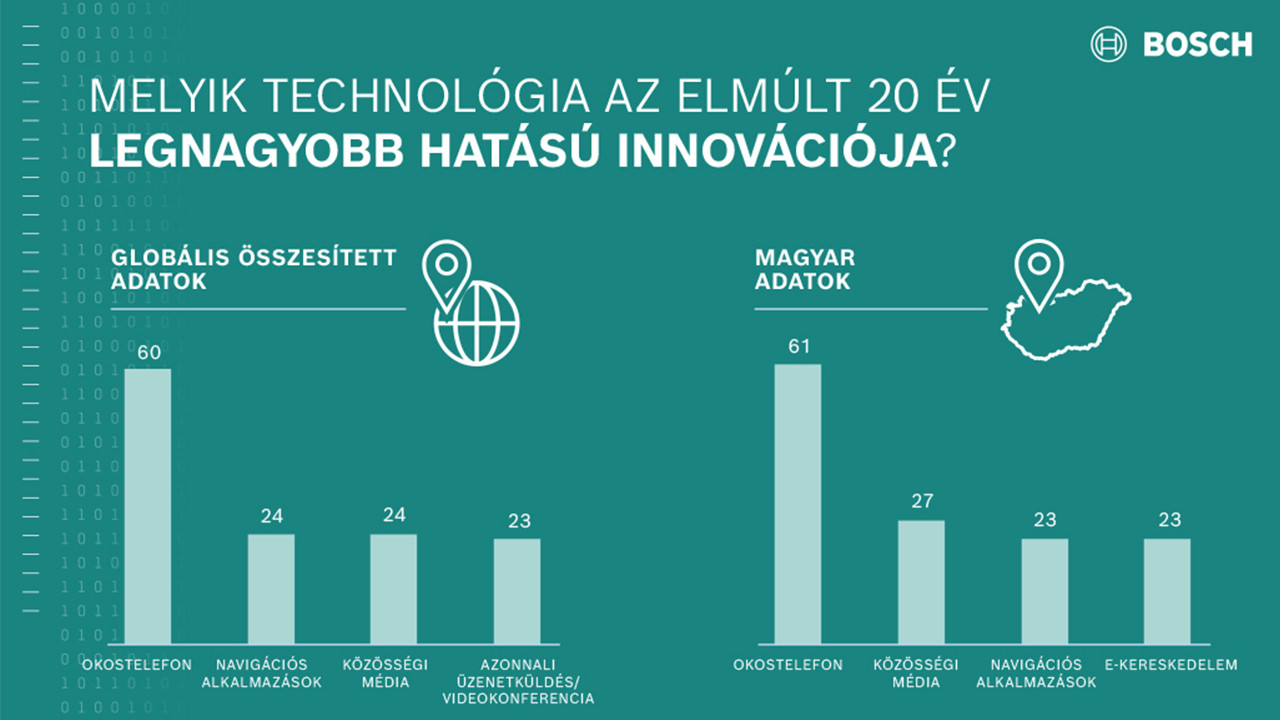
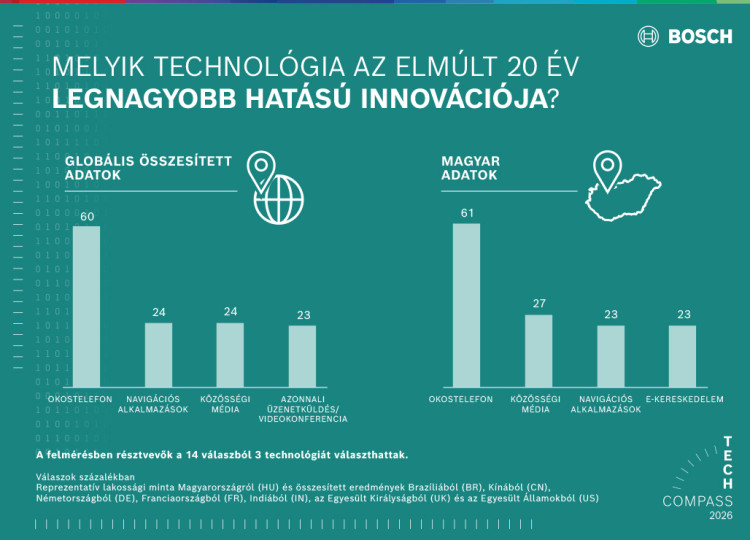
There is no doubt that the smartphone is one of the most important milestones in the technological development of the past two decades. Its impact can be felt in all areas of life. The Bosch Tech Compass survey clearly confirms its global significance. Worldwide, 60 percent of respondents (61 percent in Hungary) identified smartphones as the most defining innovation of the past 20 years. According to the respondents, technologies closely related to smartphones are also of outstanding importance. Worldwide, navigation apps (24 percent), social media (24 percent), and instant messaging/video conference (23 percent) are at the top of the ranking. In Hungary, social media (27 percent), navigation apps (23 percent), and e-commerce (23 percent) are considered to be the most important.
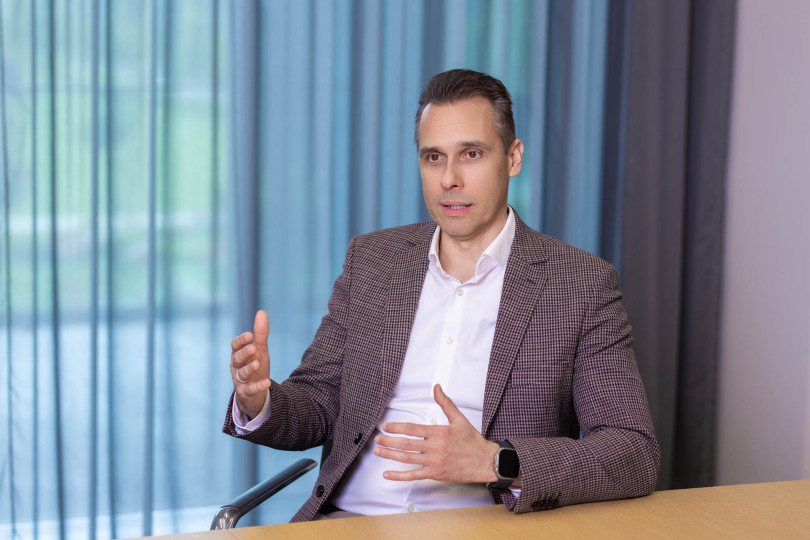
“The results of the survey reveal the central role smartphones play in our everyday lives and the power of the digital ecosystem that comes with them. It also highlights the importance of ecosystems, whether in the physical environment or in a digital one. Bosch is building a bridge between these two worlds with its expertise to offer comprehensive, connected solutions that improve people’s lives,” said István Szászi, representative of the Bosch Group in Hungary and in the Adriatic region.
The ecosystem is the driving force of innovation
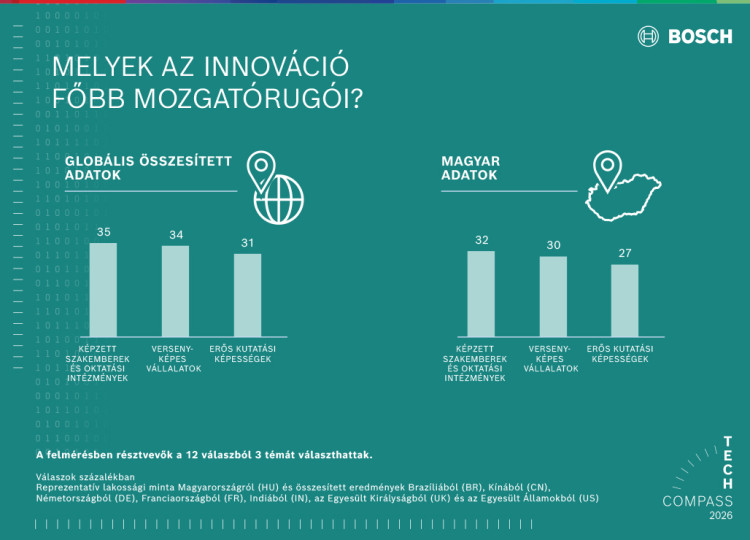
Innovation is not an isolated process, but the result of a complex ecosystem. The international research highlights the key factors that influence the innovative capacity of a nation. Globally, the greatest emphasis is placed on qualified professionals and educational institutions (35 percent) and strong research capabilities (34 percent). These are followed by competitive companies (31 percent). A similar pattern can be observed in Hungary: respondents highlighted qualified professionals and educational institutions (32 percent), competitive companies (30 percent), and strong research capabilities (27 percent) in the survey. These data support the key importance of cooperation in successful innovation processes.
“Today, the path to success clearly leads through cooperation. It is essential for Bosch to align ideas of innovation with real market needs. This requires synergy between the fresh perspectives of universities, research institutes and startups, and the complex experience of industrial players. Such an ecosystem creates marketable and people-centered solutions, innovations that benefit both the economy and society,” emphasized István Szászi.
According to Hungarians, manufacturing is the driving force of innovation in their country
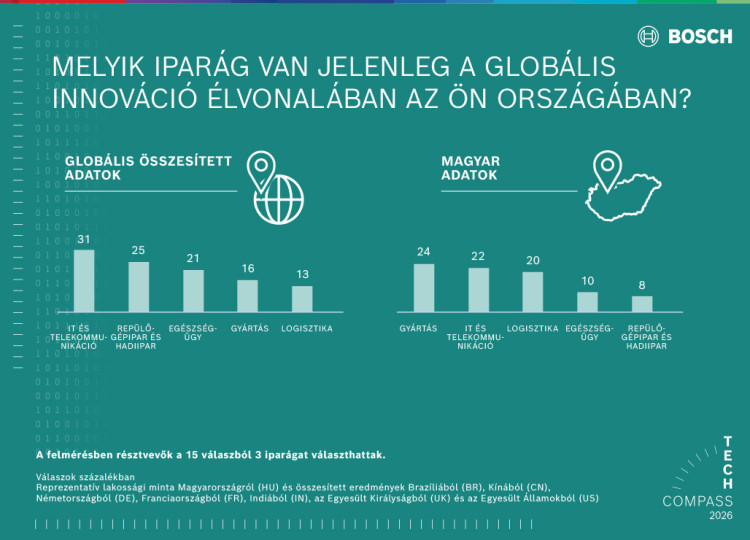
The focal points of innovation may be different from country to country. In Hungary, respondents believe that innovation is led by the manufacturing sector, which is a significant departure from global trends. 24 percent of Hungarian survey participants believe that this is the area with the most rapid development, while globally this figure is only 16 percent. IT and telecommunications (22 percent) and logistics (20 percent) are also considered to be prominent in Hungary. In contrast, IT and telecommunications (31 percent), the aerospace and defense industries (25 percent), and healthcare (21 percent) are in the forefront worldwide. In Hungary, however, the aerospace and defense industries (8 percent) and healthcare (10 percent) are less dominant on the innovation map. Hungarian data therefore show a unique national innovation profile, where, according to the survey respondents, manufacturing is the driving force behind development.
Innovative Hungarian developments
In Hungary, the Bosch Group is one of the largest foreign industrial employers as a result of close strategic cooperation of nine subsidiaries. Sustainable and economical innovations, and the implementation of opportunities provided by AI have been at the center of Bosch’s strategy for years, which is well illustrated by Hungarian developments and university collaborations.
The iconic Bosch IXO cordless screwdriver has been manufactured in Miskolc, Hungary, since 2003. The tool, which has sold more than 20 million units, is truly versatile: besides driving screws, it can also be used for a wide range of other creative tasks with the help of its accessories. The innovative power and environmental awareness of the professionals working at the power tool plant in Miskolc is symbolized by the development and sustainable production of this product. AI-based manufacturing solutions have brought significant progress to the automotive plant in Miskolc as well. The introduction of error analysis to the production lines of eBike drive units has improved the efficiency of the production process and reduced downtime. A good example of academic cooperation is the joint project between Bosch and Eötvös Loránd University (ELTE): an industrial packaging robot, which is currently operating on a test basis at the Bosch plant in Hatvan, Hungary. This AI-based equipment offers an efficient and flexible solution for unpacking, sorting, and organizing raw materials, parts, and other components that arrive to factories in a wide variety of packaging every day. The Engineering Center Budapest, which is an increasingly important location for the global development activities of Bosch, has become one of the innovation leaders in the international automotive industry over the past few years. Bosch places a strong emphasis on research and development, focusing primarily on future-shaping solutions such as automated driving, electromobility, and artificial intelligence.
“At Bosch plants and development centers in Hungary, engineers are working on ideas that provide effective and specific answers to current challenges. Creative ideas, innovations, and AI are now part of our everyday lives. From the optimization of manufacturing processes developed by Hungarian engineers to the improvement of quality and the achievement of sustainability goals, the range of applications demonstrate the versatility of the technology,” added István Szászi.
About the study
For the Bosch Tech Compass survey, the Gesellschaft für Innovative Marktforschung mbH (GIM) surveyed more than 12,000 people over the age of 18 in eight countries in the fall of 2025. The number of respondents was 1,000 in the United Kingdom, France, Hungary, and Germany each, while in the United States, Brazil, India, and China it was 2,000 each. Commissioned by the Bosch Group in Hungary, the representative survey was conducted for the second time in Hungary. Bosch was not named as a client at any point during the survey.
Mónika Hack
+36 70 510 5516
Bosch has been present in Hungary since 1898 with its products. After its re-establishment as a regional trading company in 1991, Bosch has grown into one of Hungary’s largest foreign industrial employers with currently nine subsidiaries. In fiscal 2024 it had total net sales of 2058 billion forints and consolidated sales to third parties on the Hungarian market of 313 billion forints. The Bosch Group in Hungary employs more than 17,400 associates (as of December 31, 2024). In addition to its manufacturing, commercial and development business, Bosch has a network of sales and service operations that covers the entire country.
The Bosch Group is a leading global supplier of technology and services. According to preliminary figures, it employs roughly 412,000 associates worldwide (as of December 31, 2025). The company generated sales of 91 billion euros in 2025. Its operations are divided into four business sectors: Mobility, Industrial Technology, Consumer Goods, and Energy and Building Technology. With its business activities, the company aims to use technology to help shape universal trends such as automation, electrification, digitalization, connectivity, and an orientation to sustainability. In this context, Bosch’s broad diversification across regions and industries strengthens its innovativeness and robustness. Bosch uses its proven expertise in sensor technology, software, and services to offer customers cross-domain solutions from a single source. It also applies its expertise in connectivity and artificial intelligence in order to develop and manufacture user-friendly, sustainable products. With technology that is “Invented for life,” Bosch wants to help improve quality of life and conserve natural resources. The Bosch Group comprises Robert Bosch GmbH and its roughly 490 subsidiary and regional companies in over 60 countries. Including sales and service partners, Bosch’s global manufacturing, engineering, and sales network covers nearly every country in the world. Bosch’s innovative strength is key to the company’s further development. At 136 locations across the globe, Bosch employs some 82,000 associates in research and development.
The company was set up in Stuttgart in 1886 by Robert Bosch (1861–1942) as “Workshop for Precision Mechanics and Electrical Engineering.” The special ownership structure of Robert Bosch GmbH guarantees the entrepreneurial freedom of the Bosch Group, making it possible for the company to plan over the long term and to undertake significant upfront investments in the safeguarding of its future. Ninety-four percent of the share capital of Robert Bosch GmbH is held by Robert Bosch Stiftung GmbH, a limited liability company with a charitable purpose. The remaining shares are held by Robert Bosch GmbH and by a corporation owned by the Bosch family. The majority of voting rights are held by Robert Bosch Industrietreuhand KG. It is entrusted with the task of safeguarding the company’s long-term existence and in particular its financial independence – in line with the mission handed down in the will of the company’s founder, Robert Bosch.
Additional information is available online at www.bosch.hu, iot.boschblog.hu, www.bosch.com, www.iot.bosch.com, www.bosch-press.com, www.twitter.com/BoschPresse